

Spit or Swallow: What Your Mouth Is Telling Your Brain Before You've Taken a Single Sip or Bite
Updated: Aug 3

Have we been thinking about sports nutrition backwards?
For most of its history, the field has operated on a simple assumption: you eat something, it gets digested, absorbed into the bloodstream, transported to working muscles, and then performance follows. The sequence matters. The message has always been "fuel in the tank before the engine can run".
But I've been digging deeper and seeing a growing body of research that is quietly dismantling that model, or at least complicating it in ways that change what we understand about what's actually happening when you eat, drink, or even smell something before or during exercise.
It turns out that your mouth and nose don't just receive information from the outside world. They send signals directly to your brain, and your brain responds to those signals before a single calorie has entered your bloodstream. And in some instances, sometimes that signal is enough on its own. This is the emerging science of oral and olfactory performance signalling and it raises a deceptively simple question, "What if the most important thing isn't what goes in, but what your senses detect first?"
The list below covers the research I've drawn on for this piece. It's by no means exhaustive, there's far more out there, and new studies are landing all the time. But I think it tells a great story. Have a read, get curious, and see what jumps out at you!
Chapter One: The Carbohydrate Mouth Rinse
The story starts with a finding that confused researchers when it first appeared in the literature. A group of well-trained cyclists were given a carbohydrate solution to swirl around their mouths for five seconds during a performance trial. Then they spat it out.
No swallowing. No digestion. No calories absorbed. And you guessed it, even though they didn't swallow and fuel their engine, they ultimately performed better.
Endurance performance improved by around 2.9% in events lasting 30 to 75 minutes, a margin that in competitive sport is the difference between a podium and just competed. Sprint power output increased and trial performance improved. And the effect was observed even when athletes were fasted or glycogen-depleted, conditions where you might expect a carbohydrate rinse to do nothing, given that nothing was being delivered to the muscles. So what was happening?
Your mouth has receptors for carbohydrate
The answer lies in a class of sensory receptors in the mouth and throat that respond specifically to the presence of carbohydrate, not sweetness, but carbohydrate itself. Researchers have shown this using maltodextrin (a starch-derived solution) with almost no flavour, produces the same performance benefit as a sweet glucose drink. Taste is not the mechanism, so they dug deeper as sweetness seemed to not be one of the defining factors.
The mouth receptors signal the brain directly. Neuroimaging studies have shown that rinsing with a carbohydrate solution activates reward and motor networks, including the insula, the orbitofrontal cortex, the striatum and the dorsolateral prefrontal cortex, happens within seconds. Dopamine is released and the motor cortex excitability increases. The brain interprets the carbohydrate signal as a message that fuel is incoming, and it responds by removing some of the brake that fatigue and the central nervous system normally apply during exercise. The body prepares to work harder before a single gram of glucose has reached the bloodstream.
When it works, and more importantly when it doesn't
The effect is most consistent in events lasting 30 to 75 minutes, aerobic efforts long enough to be limited by fuel availability or perceived effort, but short enough that glycogen hasn't been catastrophically depleted. It is also more pronounced in athletes who are fasted or glycogen-depleted, because in a well-fuelled state the brain is already receiving sufficient fuel signals, so rinsing has nothing really to add.
However, for sprint performance the evidence is more mixed, some studies show improvements in peak power while others don't. Most research to date has been conducted in laboratory settings on trained male athletes, so application across different sports, genders and training contexts needs more investigation. The practical protocol is almost, unbelievably simple, a small amount of carbohydrate solution, a standard sports drink works, swirled around the mouth for five to ten seconds, then spat out. No gut issues. No calorie intake. No specialist commercial drink required.
Chapter Two: The caffeine mouth rinse

If carbohydrate mouth rinsing showed that oral receptors can influence performance independently of digestion, caffeine mouth rinsing asked the follow-up question: does the same principle apply to other performance-relevant compounds?
The answer, in short, is "sometimes and depends" (as always with science!)
Caffeine's main mechanism involves blocking adenosine receptors in the brain, which reduces perceived effort and fatigue. Typically this requires absorption and systemic distribution, which is why the standard guidance is to take caffeine 45 to 60 minutes before exercise. But the mouth also has bitter taste receptors that respond to caffeine, and researchers began to wonder whether stimulating them might deliver a faster, more targeted signal to the central nervous system, AGAIN, without full ingestion.
Studies on caffeine mouth rinsing show that the results are context-dependent. A high-dose caffeine mouth rinse has been shown to significantly improve resistance training performance. Coffee mouth rinsing has shown improvements in endurance capacity in team sport players and explosive power in racket sport athletes. A 2024 systematic review found that combined carbohydrate and caffeine mouth rinsing improved both cognitive and exercise performance in with more limited and mixed effects on physical output.
Where the picture gets more complicated is in the aggregate. A systematic review pooling 16 studies found that caffeine mouth rinsing alone did not consistently improve performance across the board, suggesting that the effects are real but highly dependent:
Dose
Rinse duration
Exercise type
Athlete profile (training status, habitual caffeine intake, sports type, sex)
What does this mean in practice? Caffeine mouth rinsing is a genuinely interesting option, particularly for athletes with GI sensitivity to caffeine, or those who have already hit their preferred dose for the day and want an additional edge without the full systemic load. A pre-session coffee swill may provide some of the alerting effect without the full intake. Ultimately, it will not be a direct replacement for ingested caffeine.
Chapter Three: The dark chocolate you don't even have to eat
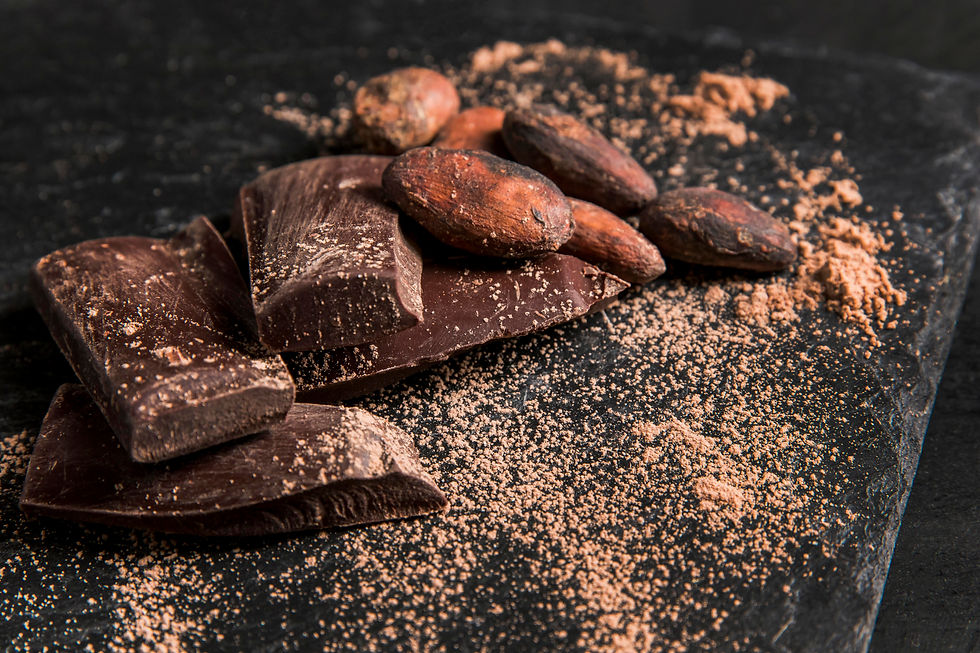
In July 2026, a study published in Frontiers in Physiology added a new dimension to this conversation, and interestingly, it had nothing to do with the mouth at all!
Twenty-three moderately trained young men completed resistance training sessions in a fasted state, performing leg extensions to failure. Before and between sets, they were exposed to one of three conditions, the scent of;
90% cocoa dark chocolate
60% cocoa milk chocolate,
Or odourless water as a control (no tasting or eating, just the scent)
The results were interesting. The group that inhaled the scent of 90% dark chocolate performed around 18 more leg extensions in total than the control group, without reporting any greater effort or exertion. Hunger, appetite and the desire to eat were all significantly reduced. The 60% milk chocolate group showed no meaningful effect on either performance or appetite.
It was specifically the high cocoa concentration that made the difference, the flavonoids, plant compounds found in high concentrations in dark chocolate that have documented effects on blood flow, inflammation and the central nervous system, rather than sweetness.
Why smell reaches the brain so directly
The olfactory system is unique in how directly it connects to the brain. Unlike every other sense, olfactory signals bypass the thalamus (the brain's central relay station which filters and routes incoming sensory information) entirely and travels to the limbic system (the amygdala, hippocampus and orbitofrontal cortex) regions that are involved in emotion, reward and appetite regulation.
The compounds in high-cocoa chocolate include flavonoids and aromatic aldehydes (naturally occurring chemical compounds responsible for much of the characteristic smell of dark chocolate) that appear to activate arousal and reward pathways in ways that increase motor drive and reduce the fatigue signal, while simultaneously suppressing appetite through the olfactory-hypothalamic connection.
My honest caveat - this is early research. Twenty-three men doing leg extensions in a lab is a very specific population and a very specific context, and real-world replication across different exercises, genders and training states hasn't been established. But the study is peer-reviewed, published in a respected journal, and an effect size of 18 extra repetitions is hard to dismiss. What would be the harm in you trying for yourself? Pretty much zero.
The Bigger Picture: You are not just a stomach
What links all three of these threads is something the sports nutrition world has been slow to fully reckon. That performance may not be determined only by what reaches the muscles via the bloodstream, it may also be shaped by what the brain perceives. Fatigue, effort, the decision to keep going or stop seem to be partly regulated centrally, by a brain constantly integrating signals from the body and adjusting its outputs accordingly. The oral carbohydrate receptors, the bitter taste receptors, the olfactory pathways , all of these are early-warning systems the brain uses to anticipate what is coming and prepare for it. And those preparations change performance.
This isn't an argument that actual nutrition doesn't matter, it absolutely does. And I want to be direct about something here, because it matters to me personally: none of these tools exist to help you eat less. The research on carbohydrate mouth rinsing works best in fasted or glycogen-depleted athletes, and that is not a state to aspire to. Chronic low energy availability, not eating enough to support the demands of your training, is one of the most common and most damaging patterns I see, particularly in women and its called "Relative Energy Deficiency in Sport" (REDs). And the consequences go far beyond performance: disrupted hormones, poor bone health, low mood and impaired recovery. The 'less is more' mentality around food is one I am deeply passionate about challenging. Eating enough to support your training, timing carbohydrate intake appropriately, maintaining adequate protein, vitamins and minerals, all of this underpins everything else. The mouth rinse is a tool that sits on top of a solid foundation. It is not a workaround for one that is missing.
But these findings do challenge a reductive view of the body as a system that only responds to what has been fully digested and absorbed. Your senses are part of the performance equation. Your brain is reading the room before the food has even arrived.
What you can actually try
If you train fasted, compete in events of 30 to 75 minutes, or hit a wall late in a session, a carbohydrate mouth rinse is a low-risk, zero-calorie tool worth experimenting with. A standard sports drink, swirled and spat, is all you need. If you're sensitive to caffeine's GI effects, or want a lighter alerting effect without the full dose, a pre-training coffee swill is worth exploring, but be realistic expectations about what it will and won't do. And for the most low-effort experiment in this entire piece: buy a bar of 90% dark chocolate, hold it under your nose before your next session, and pay attention. The only downside is the £4 spend!
The bigger point is that your body has far more performance tools than a standard fuelling plan accounts for. Taste, smell and oral sensing are all part of the larger system, so pay attention to them, as it might be one of the most under-appreciated areas of your sports nutrition.
If you'd like to take a more complete look at your performance nutrition, like how to time carbohydrate intake, structure your fuelling around different training sessions, and build a strategy that accounts for the full picture, I'd love to talk to you as this is exactly the kind of work I do at Empowering Nutrition.
Start your journey with me and start to Lean In, Learn and Level Up!
Get in touch to find out more.
References & Resources
Chambers ES, Bridge MW, Jones DA. Carbohydrate sensing in the human mouth: effects on exercise performance and brain activity. Journal of Physiology. 2009;587(8):1779-1794
Oral carbohydrate sensing enhances prefrontal cortex oxygenation, reduces perceived exertion, and improves high-intensity cycling performance: a randomised crossover trial. PLOS One. 2024
Carbohydrate in the mouth enhances activation of brain circuitry involved in motor performance and sensory perception. Appetite. 2014.
Carbohydrate in the mouth immediately facilitates motor output. Brain Research. 2010.
The Effects of Caffeine Mouth Rinsing on Exercise Performance: A Systematic Review. International Journal of Sport Nutrition and Exercise Metabolism. 2020;30(5):362–368.
High Dose of Caffeine Mouth Rinse Increases Resistance Training Performance in Men. PMC. 2021.
Caffeine Mouth Rinse Plus Ingestion Improves the 10-km Time Trial Compared to Caffeine Mouth Rinse Alone. Research Quarterly for Exercise and Sport. 2023.
Repeated mouth rinsing of coffee improves specific-endurance performance and jump performance in young male futsal players. Journal of the International Society of Sports Nutrition. 2023.
Exploring the ergogenic potential of carbohydrate–caffeine combined mouth rinse on exercise and cognitive performance: a systematic review. Applied Physiology, Nutrition, and Metabolism. 2024.
The acute effects of caffeine, creatine, and carbohydrate mouth rinse combined with conditioning activity on subsequent sports performance: a systematic review and Bayesian meta-analysis. Frontiers in Nutrition. 2025.
Chocolate odour and exercise performance study. Frontiers in Physiology. July 2026.


Comments